

Blog
How to Make Onion Oil at Home: 4 Essential Steps & Tips


How to Make Onion Oil at Home: 4 Essential Steps, Hair Benefits, and Safety Tips
Healthy-looking hair is something many people want, yet concerns such as dryness, breakage, thinning, and excessive shedding can make everyday hair care frustrating. When conventional products do not deliver the expected results, it is natural to become interested in traditional ingredients such as onions, coconut oil, fenugreek, and black seed.

Among these ingredients, onion oil has become especially popular in homemade hair-care routines.
But does onion oil really help with hair growth? Is it safe for every scalp type? Should onions be cooked over high heat or gently infused into oil? Most importantly, how can you prepare a homemade onion oil without overlooking important safety precautions?
If you are searching for how to make onion oil at home, this comprehensive guide explains the traditional preparation method, ingredient selection, potential cosmetic benefits, application techniques, common mistakes, and storage concerns.
We will also examine what scientific research actually says about onion-based hair remedies so you can separate traditional beliefs from established evidence.
1. What Is Onion Oil?
Onion oil is generally a carrier oil, such as coconut or sesame oil, into which onions have been infused.
During preparation, chopped onions are exposed to the carrier oil, sometimes with gentle heating. The intention is to transfer certain onion constituents and aroma into the oil.
Onion oil has been used in traditional beauty routines because onions contain sulfur-containing compounds and antioxidants.
However, the amount and type of onion compounds transferred into oil can vary considerably depending on the ingredients, preparation temperature, duration, and other factors.
This means that not every homemade onion oil preparation has the same chemical composition or potential effects.
Why Do People Use Onion Oil for Hair?
People commonly use onion oil as part of a routine intended to improve the appearance and manageability of their hair.
Some apply it before shampooing to make dry hair feel softer, while others use it during scalp massage.
A number of popular claims also suggest that onion oil can stimulate hair growth, reduce hair fall, eliminate dandruff, and strengthen hair roots.
Although these claims are widely repeated online, they are not all supported by reliable clinical evidence.
Understanding this difference is essential before adding onion oil to your routine.
Is Homemade Onion Oil the Same as Onion Juice?
No. Onion juice and onion-infused oil are different preparations.
Onion juice is a water-based liquid extracted from fresh onions. An onion-infused oil uses a fatty carrier oil to hold whatever onion constituents transfer during preparation.
Different chemical compounds dissolve differently in water and oil.
For this reason, results from a study using fresh onion juice cannot automatically establish the effectiveness of homemade onion oil.
2. The Science Behind Onion Oil and Hair Care
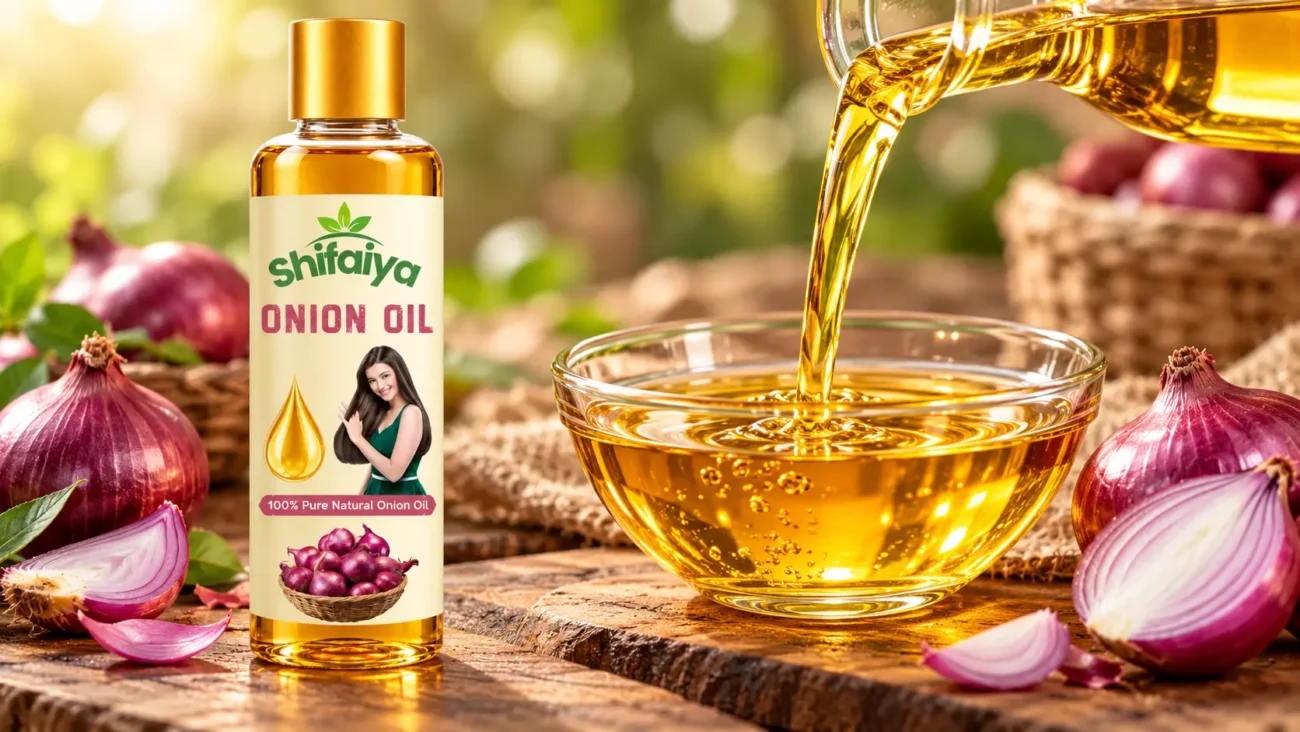
To understand the possible effects of onion oil, it helps to know a little about the structure of human hair.
Each hair grows from a follicle located in the skin. The visible hair shaft consists mainly of keratin, a structural protein.
Keratin contains amino acids, including cysteine, whose sulfur-containing bonds contribute to hair structure.
Onions also contain sulfur-containing compounds. However, this does not mean that applying onion oil supplies the hair follicle with the sulfur it needs to produce new hair.
Hair growth depends on complex biological processes, including genetics, hormones, nutritional status, and follicle health.
Sulfur Compounds in Onions
Onions contain various organosulfur compounds responsible for much of their characteristic aroma.
These compounds have attracted scientific interest because of their chemical and biological properties.
However, the sulfur-containing compounds in onions are not equivalent to a proven topical treatment for hair loss.
There is also insufficient evidence that a typical homemade onion-oil infusion delivers them to the hair follicle in a concentration capable of stimulating growth.
What Is Quercetin?
Quercetin is a flavonoid antioxidant found naturally in onions and certain other plant foods.
Antioxidants can participate in reactions involving oxidative stress, but the presence of an antioxidant in an ingredient does not automatically mean the finished cosmetic product has a clinically meaningful effect.
How much quercetin enters a homemade oil infusion depends on preparation conditions and its chemical properties.
Therefore, claims that homemade onion oil repairs damaged follicles or reverses baldness should be treated cautiously.
What Does Clinical Research Say?
One frequently discussed study was published in The Journal of Dermatology in 2002.
Researchers examined crude onion juice applied to people with patchy alopecia areata, an autoimmune condition associated with hair loss.
The small study reported encouraging observations compared with a tap-water control group.
However, it had important limitations, including its size and the specific condition being studied.
It did not test homemade onion oil, and its findings do not establish onion oil as an effective treatment for hereditary hair loss or other causes of thinning.
Scientific reference: Onion Juice (Allium cepa L.), a New Topical Treatment for Alopecia Areata – PubMed
3. Potential Benefits of Homemade Onion Oil
Although homemade onion oil has not been established as a medical treatment for hair loss, certain carrier oils can provide cosmetic benefits.
The results you notice may depend more on the chosen carrier oil and your hair condition than on the onion infusion.
May Improve Hair Softness
Dry hair often feels rough because the surface of the hair shaft does not retain sufficient lubrication.
Applying an appropriate hair oil may help reduce friction between strands, making hair feel smoother and easier to comb.
This is especially relevant for hair exposed to frequent washing, harsh styling, or environmental dryness.
May Reduce Certain Types of Hair Damage
Coconut oil has been studied for its effects on hair protein loss.
A 2003 study by Rele and Mohile compared coconut oil with mineral and sunflower oils.
The researchers found that coconut oil reduced protein loss in the hair under the tested conditions.
This finding supports certain conditioning benefits of coconut oil, not a claim that onion oil stimulates new hair growth.
Research: Effect of Mineral Oil, Sunflower Oil, and Coconut Oil on Prevention of Hair Damage – PubMed
May Make Hair More Manageable
An oil-based pre-shampoo treatment may improve how easily some people detangle their hair.
Less friction during combing may help reduce mechanical damage, particularly when the hair is dry or fragile.
However, using excessive amounts can leave the hair feeling heavy or greasy.
Can Support a Gentle Hair-Care Routine
The act of applying an oil slowly and gently may encourage more careful hair handling.
Light massage can also be relaxing.
However, scalp massage should not be confused with a proven treatment for hair regrowth.
Important: Softer hair, reduced breakage, and new hair growth are different outcomes. A cosmetic improvement should not be presented as proof that a hair-loss condition has been treated.
4. Ingredients Needed for Homemade Onion Oil
Choosing appropriate ingredients is one of the most important parts of learning how to make onion oil at home.
Simple formulations are generally easier to understand and may be preferable for someone who has never used onion-based scalp preparations.
Red Onion
Traditionally, red onions are often selected for homemade onion oil.
For a small batch, one small fresh red onion is sufficient.
Choose an onion without mold, soft spots, or visible spoilage.
Although darker onions may contain different amounts of certain plant pigments, their color alone does not establish that they are more effective for hair growth.
Coconut Oil
Coconut oil is a common carrier oil for hair conditioning.
It contains a high proportion of lauric-acid-containing triglycerides and has been studied for its interaction with hair fibers.
It is often used before washing, particularly on dry hair lengths.
Nevertheless, coconut oil may feel too heavy for some hair types, and not everyone tolerates it on the scalp.
Sesame Oil
Sesame oil is another traditional carrier oil.
It has a different fatty-acid composition and texture from coconut oil.
People with sesame allergies should avoid it, and anyone with a sensitive scalp should introduce new oils carefully.
Mustard Oil
Mustard oil is used in some traditional hair-care practices, particularly in South Asia.
However, mustard oil can irritate sensitive skin.
Its strong aroma may also be unsuitable for people who prefer lightly scented products.
It should not automatically be considered safer or more effective than other carrier oils.
Fenugreek Seeds
Fenugreek seeds, commonly called methi dana, are included in various traditional botanical preparations.
They contain several plant constituents, but there is insufficient robust clinical evidence that adding fenugreek to onion oil reliably accelerates hair growth.
Fenugreek can also trigger allergic reactions in susceptible individuals.
Black Seeds (Kalonji)
Black seeds are obtained from Nigella sativa.
They are commonly included in traditional herbal mixtures.
While black seed has been investigated for several biological properties, this does not establish that adding it to homemade onion oil treats scalp infections, dandruff, or hair loss.
Curry Leaves
Curry leaves are sometimes used in homemade hair-oil preparations.
They may contribute a botanical aroma, but evidence that they prevent premature graying or restore natural hair color is inadequate.
For beginners, using fewer ingredients may be more sensible than combining multiple herbs immediately.
5. How to Make Onion Oil at Home: 4 Essential Steps
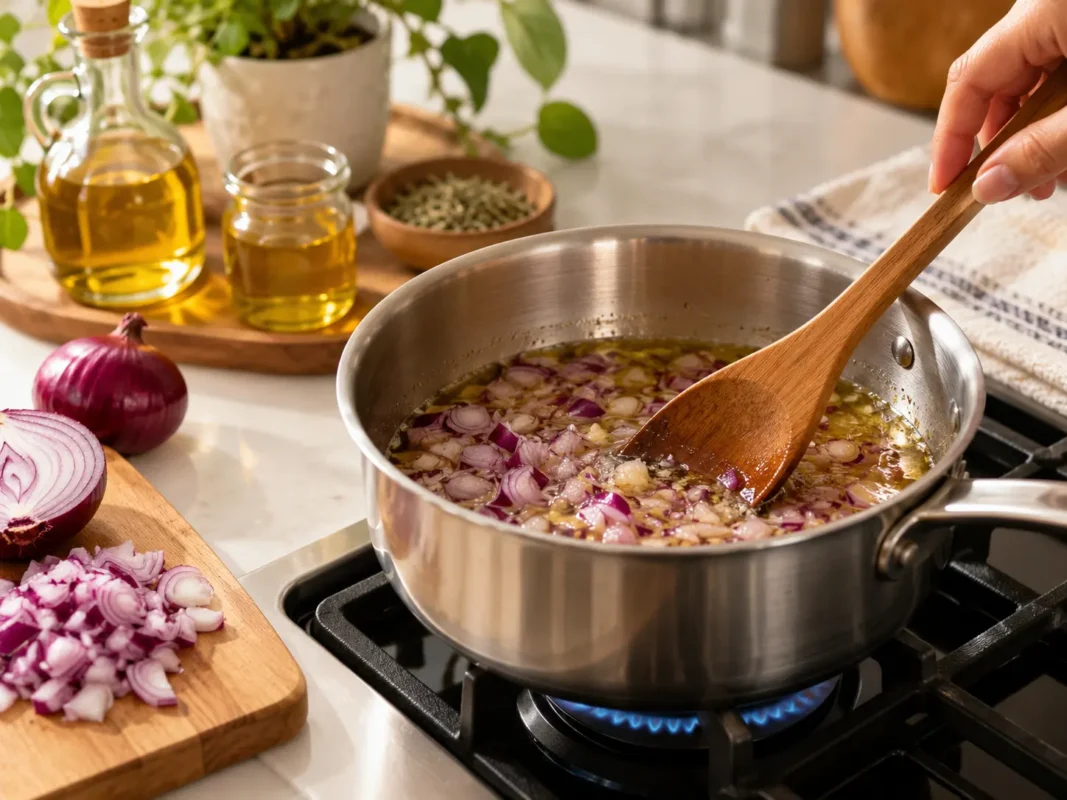
The following is a traditional preparation method using fresh onion and a carrier oil.
Safety limitation: This method is not a validated cosmetic manufacturing or preservation process. Fresh onions contain moisture, and straining or gentle heating does not guarantee microbial safety. Do not treat the finished mixture as a shelf-stable product.
Step 1: Prepare the Onion
Select one small, fresh red onion.
Wash it thoroughly under clean running water and remove the outer peel.
Cut the onion into small pieces using a clean knife and chopping board.
Pat the pieces with a clean towel to remove visible surface moisture.
Avoid adding water during chopping or blending.
Remember that onions naturally contain water internally, so drying the outside does not make the onion completely moisture-free.
This distinction is particularly important when preparing an infusion intended for skin contact.
Step 2: Select a Suitable Carrier Oil
Measure approximately half a cup of a carrier oil you have previously tolerated.
For example, coconut oil may be suitable for people looking for a traditional pre-shampoo conditioning treatment.
Choose a clean, dry, thick-bottomed saucepan.
Ensure that cooking utensils are free of residual water.
Do not mix several unfamiliar botanical oils together on your first attempt.
Keeping the formula simple makes it easier to identify a potential source of irritation.
Step 3: Gently Heat the Ingredients
Place the saucepan over very low heat.
Add the chosen carrier oil and carefully introduce the chopped onion.
Stir gently while monitoring the mixture.
Avoid vigorous frying, smoking oil, or darkening the onion pieces to the point of burning.
Remove the pan from the heat if the oil begins to smoke or the ingredients scorch.
Gentle heating provides better control, but it does not guarantee preservation of every beneficial compound.
Likewise, there is no reliable visual sign-such as translucent onion pieces or the disappearance of bubbles that proves all moisture and microorganisms have been eliminated.
For this reason, a homemade preparation should never be assumed to be safe for prolonged storage simply because it was heated.
Step 4: Cool and Strain the Oil
Switch off the heat and allow the preparation to cool safely.
When it is no longer hot, use a clean, dry strainer to remove the onion pieces.
Avoid handling hot oil directly.
The strained liquid may have a golden to amber appearance, depending on the carrier oil, onion, and heating conditions.
Color is not a reliable indicator of purity, effectiveness, or microbial safety.
Even after straining, small amounts of moisture may remain.
Prepare only a small amount for immediate use, and discard leftovers rather than storing a fresh-onion infusion for an extended period.
Key takeaway: Knowing how to make onion oil at home includes recognizing the limitations of a fresh, homemade preparation. Gentle heating may prevent scorching, but it cannot replace proper product safety testing.
6. Why Low Heat Is Preferable to High Heat
Many homemade oil tutorials recommend cooking onions until they turn dark brown or almost black.
This approach can lead to unnecessary overheating.
Problems With Excessive Heating
High temperatures may cause onions to scorch, affect the smell and appearance of the oil, and accelerate some forms of oil degradation.
The resulting product may have an unpleasant burnt aroma.
For a cosmetic preparation, such changes are undesirable.
However, it would be misleading to claim that every onion compound becomes toxic at a specific temperature.
The chemistry of heated plant ingredients is considerably more complex.
Does Low Heat Protect All Nutrients?
Not necessarily.
Different compounds have different sensitivities to heat, oxygen, moisture, and light.
Gentle heating may reduce certain types of thermal damage but cannot preserve every compound unchanged.
It also does not guarantee that ingredients will transfer efficiently into the carrier oil.
Can Heating Make Onion Oil Safe to Store?
Not through this simple household method alone.
Fresh onion is a moisture-containing ingredient, and a mixture of water-containing plant matter and oil requires careful safety consideration.
A stable commercial cosmetic product may use controlled manufacturing conditions, suitable ingredients, validated preservation, and appropriate testing.
A traditional kitchen infusion should not be treated as equivalent to a professionally evaluated cosmetic formula.
How to Make Onion Oil at Home: Video Tutorial
7. How to Reduce the Strong Smell of Onion Oil
Onions have a distinctive smell largely associated with sulfur-containing compounds.
Some people enjoy traditional herbal aromas, while others find onion-based products difficult to tolerate.
Fortunately, there are practical ways to make application more comfortable.
Avoid Burning the Onion
Scorched onion can develop a harsher aroma.
Using gentle heat instead of aggressive frying may help avoid that problem.
Use a Smaller Amount
Adding excessive onion to a small volume of carrier oil may produce a stronger-smelling preparation.
There is no established evidence that using more onion automatically provides greater hair benefits.
Wash With an Appropriate Shampoo
After application, gently wash your hair using a shampoo suitable for your scalp and hair type.
Rinse thoroughly.
If necessary, follow with a conditioner applied mainly to the hair lengths.
You do not need to use a sulfate-free shampoo in every case; choose a cleansing product your scalp tolerates.
Should You Add Essential Oils?
Rosemary and lavender essential oils are sometimes suggested to mask onion odors.
However, essential oils are concentrated ingredients and may cause irritation or allergic reactions.
There is no reliable basis for claiming that adding them makes onion oil several times more effective.
Avoid adding essential oils casually, especially if you have a sensitive scalp.
8. How to Store Homemade Onion Oil Safely
Storage is one of the most commonly misunderstood aspects of homemade onion oil.
Some online recipes claim that adding vitamin E capsules or straining the oil allows it to remain fresh for three to six months.
Such claims should not be accepted without appropriate evidence.
Why Moisture Matters
Fresh onions contain a considerable amount of water.
When moisture remains in an oil-based preparation, microbial contamination becomes an important concern.
The risk depends on the formulation, preparation conditions, contamination, and storage environment.
A product can appear normal while still presenting safety concerns.
Does Vitamin E Work as a Preservative?
Vitamin E is primarily used for its antioxidant properties.
Antioxidants may help limit certain oxidation processes, but they are not equivalent to an effective antimicrobial preservation system.
Therefore, adding vitamin E does not guarantee that homemade onion oil is safe from microbial growth.
Can Onion Oil Be Refrigerated?
Refrigeration does not automatically make a fresh-onion oil infusion safe for a specific number of days.
There is no universal scientifically validated shelf life for home-prepared onion oil.
Avoid relying on arbitrary claims such as seven days, thirty days, or six months.
For a traditional preparation made with fresh onion, the more cautious option is to prepare a small amount for immediate use rather than keeping leftovers.
A More Practical Alternative
If convenience and predictable storage are important, consider a professionally formulated hair oil with a clearly labeled ingredient list, batch information, directions for use, and suitable shelf-life guidance.
A cosmetic product should be evaluated on its formulation, manufacturing quality, and safety information-not simply on whether its ingredients are described as natural.
9. How to Apply Onion Oil to Your Hair
The correct application method matters just as much as the preparation itself.
Even a relatively simple oil-based formula can cause problems if applied excessively or to irritated skin.
Start With Skin Tolerance
Before applying any unfamiliar preparation widely, check whether your skin tolerates the ingredients.
A small-area skin test may help reveal obvious irritation, but it cannot establish microbial safety or guarantee that a reaction will not occur later.
Do not use onion oil on broken, inflamed, or infected skin.
Apply a Small Amount
Place a little oil on your fingertips and gently spread it over the intended area.
Avoid saturating the scalp unnecessarily.
If your main concern is dry hair lengths rather than the scalp, applying a suitable plain conditioning oil to the hair lengths may be more appropriate.
Massage Gently
Use your fingertips rather than your nails.
Avoid vigorous rubbing, particularly if you already have scalp sensitivity or inflammation.
Massage should feel comfortable and should never cause pain.
How Long Should It Stay On?
There is no established scientific duration that guarantees better results from homemade onion oil.
If you choose to try it, start with brief contact and pay attention to your scalp.
Leaving it on overnight is not necessary.
Immediately wash it off if you notice stinging, burning, redness, or itching.
Wash and Condition
Use lukewarm water and a shampoo that suits your hair type.
Rinse carefully and avoid aggressive scrubbing.
Follow with conditioner if needed, especially on dry or damaged hair lengths.
How Often Should You Use It?
No scientifically validated weekly schedule exists for homemade onion oil.
Using it more frequently does not necessarily improve results.
If you experience ongoing irritation or hair loss, discontinue use and seek appropriate professional guidance.
10. Common Mistakes to Avoid When Making Onion Oil
When learning how to make onion oil at home, understanding common mistakes can help you make more informed choices.
Mistake 1: Burning the Onion
Cooking onion pieces until they are blackened can produce an unpleasant-smelling, degraded preparation.
Avoid aggressive heating.
Mistake 2: Assuming Natural Means Safe
Natural ingredients can cause allergic reactions, irritation, or contamination-related problems.
An ingredient’s botanical origin does not guarantee skin compatibility.
Mistake 3: Adding Too Many Herbs
Combining onion, fenugreek, black seed, curry leaves, mustard oil, and essential oils increases formulation complexity.
If irritation develops, identifying the responsible ingredient becomes difficult.
Mistake 4: Storing Fresh Onion Oil for Months
Without appropriate testing and preservation, long storage periods should not be recommended.
Straining the preparation does not reliably remove all moisture.
Mistake 5: Expecting Guaranteed Hair Growth
Hair thinning and shedding have many possible causes.
A cosmetic oil cannot be expected to resolve every underlying condition.
Mistake 6: Ignoring Scalp Irritation
Burning or itching is not evidence that the product is working.
These symptoms may indicate irritation.
Stop using the product if a reaction occurs.
Mistake 7: Replacing Medical Care With Home Remedies
Persistent hair loss may require professional diagnosis.
Delaying evaluation can allow some conditions to progress.
11. Onion Oil vs. Coconut Oil: What Is the Difference?
Onion oil and plain coconut oil are sometimes treated as interchangeable, but they are not the same.
Plain coconut oil is a single carrier oil with known general characteristics.
Homemade onion oil is a mixture whose composition may change according to preparation.
Coconut Oil for Hair Conditioning
Research suggests that coconut oil can help reduce protein loss from hair in certain circumstances.
This makes it a reasonable ingredient to consider for cosmetic hair conditioning, provided it suits the individual.
Onion Oil for Hair Growth
The evidence for homemade onion oil stimulating hair growth is much less established.
Research on onion juice does not demonstrate that an oil infusion will deliver the same effects.
Which One Should You Choose?
If your priority is improving the feel of dry hair, a suitable plain carrier oil may be a simpler option.
If you have unexplained shedding or thinning, identifying the cause is more important than choosing between two oils.
No single oil works equally well for every hair type or scalp condition.
12. When Hair Loss Needs Professional Attention
Hair shedding is part of the normal hair-growth cycle.
According to the American Academy of Dermatology, losing approximately 50 to 100 hairs per day can be normal.
However, noticeable thinning, sudden shedding, or bald patches deserve attention.
Common Causes of Hair Loss
Possible causes include hereditary hair loss, hormonal changes, thyroid problems, significant illness, certain medications, nutritional deficiencies, scalp disorders, and traction from tight hairstyles.
Some types of hair loss improve when the underlying cause is addressed.
Others require specific treatment.
Warning Signs to Watch For
Consider speaking with a dermatologist if you notice a rapidly widening hair part, bald patches, persistent scalp pain, severe itching, unusual scaling, or sudden heavy shedding.
A dermatologist may evaluate your scalp, review your medical history, and recommend tests when appropriate.
Medical reference: American Academy of Dermatology – Hair Loss: Overview
Can Hair Oils Replace Proven Treatment?
No.
A conditioning oil may improve the feel or appearance of hair, but it does not replace evidence-based treatment for diagnosed hair-loss conditions.
The American Academy of Dermatology discusses treatments such as minoxidil for appropriate patients, depending on the diagnosis.
Read more: Hair Loss: Diagnosis and Treatment – AAD
13. Frequently Asked Questions About Onion Oil
FAQ 1: Does Homemade Onion Oil Really Grow Hair?
There is not enough high-quality clinical evidence to conclude that homemade onion oil reliably promotes new hair growth. A small study investigated onion juice for alopecia areata, but its findings should not be applied directly to homemade onion oil. Individuals with persistent hair loss should seek professional advice rather than relying on an unproven remedy.
FAQ 2: How Long Does Onion Oil Take to Show Results?
There is no established timeline for hair growth from homemade onion oil because its effectiveness for that purpose has not been demonstrated. Some people may notice temporary improvements in hair softness or manageability from the carrier oil, but those effects are different from new hair growth.
FAQ 3: Can Onion Oil Stop Hair Fall Permanently?
No evidence shows that homemade onion oil can permanently stop hair loss. Hereditary, hormonal, nutritional, autoimmune, and other causes require different approaches. Proper diagnosis is particularly important when thinning is progressive or accompanied by scalp symptoms.
FAQ 4: Can I Apply Onion Oil Every Day?
Daily use is not necessary, and there is no clinically established schedule for homemade onion oil. Frequent application may leave some scalps greasy or irritated. If you experience itching, redness, or discomfort, discontinue use rather than increasing the amount or frequency.
FAQ 5: Is Onion Oil Suitable for Dry and Damaged Hair?
A carrier oil such as coconut oil may help some people manage dry or damaged hair by reducing friction and improving lubrication. However, the additional benefits of onion infusion are uncertain. A simple conditioning oil may be preferable if you have a sensitive scalp.
FAQ 6: Can Onion Oil Cure Dandruff?
Homemade onion oil is not an established treatment for dandruff. Dandruff may involve seborrheic dermatitis and other scalp conditions. Depending on the cause, a suitable anti-dandruff shampoo or dermatological treatment may be more appropriate than a homemade infusion.
FAQ 7: Can I Leave Onion Oil on My Scalp Overnight?
Overnight application is not required, and prolonged contact may increase irritation in susceptible people. Begin with limited exposure if you choose to try a new preparation. Wash it off immediately if the scalp becomes uncomfortable.
FAQ 8: Can I Add Rosemary Oil or Vitamin E to Onion Oil?
These ingredients are sometimes used in cosmetic formulations, but they serve different purposes. Vitamin E is not a substitute for antimicrobial preservation. Rosemary essential oil is concentrated and may cause irritation if incorrectly used. Adding either ingredient does not guarantee improved hair growth or storage safety.
FAQ 9: How Long Can Homemade Onion Oil Be Stored?
No universal safe shelf life has been established for oil infused with fresh onions under household conditions. Moisture, contamination, preparation methods, and storage conditions affect safety. It is more cautious to prepare a small batch for immediate use and discard leftovers rather than assuming it can be stored for weeks or months.
FAQ 10: What Should I Do If Onion Oil Causes Itching or Burning?
Stop using the preparation immediately and gently wash it off. Avoid applying additional essential oils or harsh products to the irritated area. If redness, swelling, pain, or itching persists, seek professional medical advice. Severe allergic symptoms require urgent medical attention.
14. Final Thoughts: Is Homemade Onion Oil Worth Trying?
Learning how to make onion oil at home can help you understand traditional hair-care practices and the importance of choosing suitable ingredients.
However, homemade onion oil should be approached realistically.
It is not a scientifically established cure for baldness, dandruff, or persistent hair loss.
Some people may appreciate the conditioning effects of the carrier oil, but evidence for additional benefits from onion infusion remains limited.
Gentle preparation can help prevent scorching, yet it does not solve every concern related to moisture, contamination, or shelf life.
For anyone with sensitive skin, unexplained shedding, or persistent scalp problems, simpler formulations and professional guidance may be more appropriate.
At Shifaiya Care, we believe good hair-care decisions begin with understanding ingredients, recognizing the limits of available research, and choosing products with care.
Explore more information about hair care, skin care, and natural beauty at Shifaiya Care.
Medical Disclaimer: This article provides general educational information and is not intended to diagnose, treat, cure, or prevent a medical condition. Consult a qualified healthcare professional for persistent hair loss, scalp disease, or concerns about ingredient sensitivity.
Scientific References
- Sharquie KE, Al-Obaidi HK. Onion Juice (Allium cepa L.), a New Topical Treatment for Alopecia Areata. The Journal of Dermatology, 2002. View on PubMed
- Rele AS, Mohile RB. Effect of Mineral Oil, Sunflower Oil, and Coconut Oil on Prevention of Hair Damage. Journal of Cosmetic Science, 2003. View on PubMed
- American Academy of Dermatology. Hair Loss: Overview. Read the Guide
- American Academy of Dermatology. Hair Loss: Diagnosis and Treatment. Read the Guide
- Dias MFRG. Hair Cosmetics: An Overview. International Journal of Trichology, 2015. Read on PubMed Central
Connect With Shifaiya Care
Stay connected with Shifaiya Care for more research-informed hair-care guides, skin-care information, natural beauty discussions, and practical self-care tips.
- Website: www.shifaiya.com
- Facebook: @shifaiya.care
- Instagram: @shifaiya.care
- TikTok: @shifaiya.care
- YouTube: @shifaiyacare
- WhatsApp: 0310-1208111
Shifaiya Care – Natural Beauty, Informed Choices, and Thoughtful Care.


